
Did You Know? How to Spend Obon and Regional Timing Differences to Watch Out For
Obon is a period for honoring and paying respects to our ancestors. Some of you may return to your hometown every year for this occasion. Actually, the timing of Obon varies by region. Additionally, some regions hold their own unique events during this time. Knowing the regional differences and history might make each year’s Obon a little more enjoyable. In this article, we’ll introduce the timing, history, and customs of Obon.
Surprisingly Different! Obon Timing and Regional Variations
The general Obon period is the four days from August 13th to 16th. However, in some regions, it can shift by about a month. Let’s look at the representative Obon periods below.
1: Almost the entire country (August 13th–16th)
Around 1873, when Japan switched to the new (solar) calendar, many regions shifted the old lunar calendar’s Obon period (July 13th–16th) by one month to align with the new calendar. Since this is close to the old lunar Obon, it’s sometimes called “Kyu-Bon” or “Old Obon.”
2: Urban Tokyo and parts of Kanazawa City, Shizuoka City, etc. (July 13th–16th)
In these regions, Obon is observed on the same dates as the old lunar calendar, regardless of the switch to the new calendar. Since this actually shifted from the original lunar calendar timing, it’s sometimes called “Shin-Bon” (New Obon) or “Tokyo Bon.” Incidentally, “Niibon” refers to the first Obon after the 49-day memorial service following a death—so be careful not to confuse the two terms.
3: Okinawa Prefecture and the Amami region of Kagoshima Prefecture (Old lunar calendar July 13th–16th)
In these regions, the timing of Obon is still determined based on the old lunar calendar. As a result, the dates change from year to year. In practice, it’s often held over a shorter three-day period from the 13th to 15th of the old lunar calendar’s 7th month, and on the third day, the traditional performing art “Eisa” (equivalent to Bon dancing) may be performed. As you can see, Obon is observed over various periods depending on the region. That said, the meaning and basic customs of Obon are similar everywhere. So how did Obon originally begin, and what meaning did it come to hold?
Now You Know! The History, Meaning, and Customs of Obon
・The History and Meaning of Obon
The custom of Obon is said to have originated from the ancient practice of “honoring one’s ancestors,” combined with the Buddhist event known as “Urabon-e.” “Urabon-e” comes from the Buddhist sutra called the “Urabon-kyo,” and “Urabon” itself is said to originate from the Sanskrit word “Ullambana,” meaning “hanging upside down.”
“Ullambana” (hanging upside down) refers to a legend about Mokuren, one of the Buddha’s disciples. One day, Mokuren discovered that his deceased mother was suffering the punishment of being hung upside down in hell. When he asked the Buddha how to save her, he was told, “Hold a memorial service on the 15th day of the 7th month (of the lunar calendar).” This teaching is said to have led to the Obon tradition we know today.
Given this origin, Obon today remains a custom for honoring ancestors and the deceased. The main purpose of Obon is to welcome ancestors from the afterlife (the Pure Land) back to this world (the present life), and to pray for their happiness (peace in the afterlife) after they return to the afterlife.
・How to Spend Obon
Given its meaning, there are specific things to do on each day of Obon. Let’s look at how Obon is typically observed, using the common “Kyu-Bon” period (August 13th–16th) as an example.
・Day 13: Welcoming the Ancestors
On the evening of the first day of Obon, a “mukaebi” (welcoming fire) is lit as a marker at the gate of one’s home to welcome the ancestors. Traditionally, the mukaebi is made by placing hemp stalks called “ogara” on an unglazed clay dish called a “horoku” and burning them, but nowadays, electric Bon lanterns are often used instead.
・Days 14–15: Entertaining the Ancestors
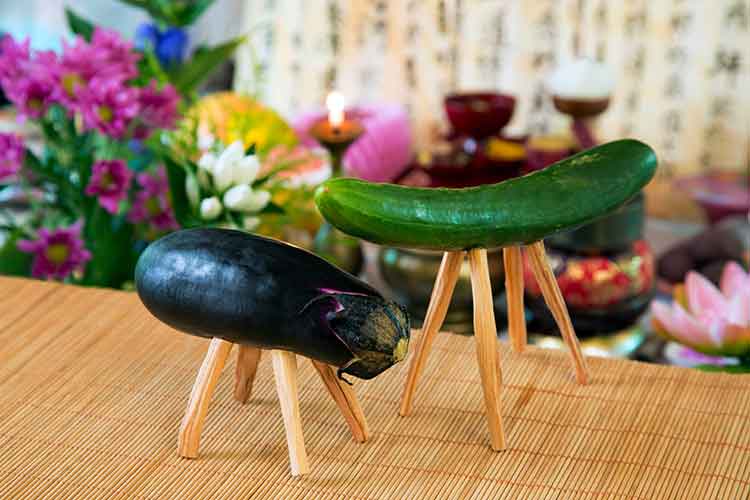
During the middle two days, the ancestors—who are said to reside on the “Bon-dana” (Obon altar)—are entertained as guests. First, a straw or reed mat is laid out, and a Bon altar with the ancestral tablet placed in the center is created. Offerings such as cucumber “horses” and eggplant “cows,” as well as “mizu no ko” (washed rice mixed with diced eggplant and cucumber), are placed on the altar, with lanterns and paper lanterns displayed on either side. Sometimes, the deceased’s favorite foods from when they were alive are also offered.
・Day 16: Sending Off the Ancestors
After making offerings until early afternoon, an “okuribi” (sending-off fire) is lit in the evening to send the ancestors off. In some regions, lantern floating (toro nagashi) or spirit floating (shoryo nagashi) ceremonies are held instead of the okuribi. Once the okuribi is safely completed, the Obon decorations are put away that same day.
In addition to these customs, Obon is observed in various ways depending on the region—such as performing Bon dances as offerings, or visiting family graves to leave offerings. While the way Obon is observed varies depending on one’s region or Buddhist sect, the purpose of “welcoming and sending off one’s ancestors” remains common to all. By understanding the meaning and history of Obon and observing it thoughtfully, your feelings of gratitude and remembrance toward your ancestors may come across even more clearly. It might be fun to look into how Obon is observed in your own region once again.
 中文 (台灣)
 한국어
한국어 日本語
日本語関連記事一覧
Comment ( 0 )
Trackbacks are closed.
No comments yet.