
How Many Do You Know? Manners Surrounding Zabuton Cushions
The zabuton (Japanese floor cushion) helps ease the strain on your legs and back when sitting on the floor in a tatami room. Beyond everyday use at home, zabuton also play a role in various settings, such as rakugo (comic storytelling) performances and ozagishiki-style comedy quiz shows. Although we tend to use zabuton without much thought, do you know about their history and the proper etiquette surrounding them? In this article, we’ll introduce the history of the zabuton, how to sit on one, and the manners involved.
Evolving Alongside Tatami: The History of the Zabuton
The zabuton developed hand in hand with the history of tatami mats. Let’s take a look at how this unfolded.
・Origins in the Heian Period
The zabuton evolved from the “shitone,” a cushion used by aristocrats during the Heian period (794–1185). The shitone was a square cushion made from a material called “uwamushiro,” which was used like a futon mattress, and was reportedly made from animal hide and similar materials. Since the tatami itself was soft at the time, there was no need to make the shitone thick, so it was thinner than today’s zabuton. As the shitone was a seating item used by aristocrats, its color, pattern, and quality were determined by the user’s rank and social status.
・Taking Its Current Form in the Edo Period
By the Edo period (1603–1868), tatami mats had evolved to become firmer and more durable, which meant that sitting on the thin shitone started to hurt one’s legs. In response to this change, the shitone was stuffed with silk floss, evolving into a thick, soft cushion. Around this time, cushions stuffed with cotton—cheaper than silk floss—also began to appear, and the custom of using zabuton reportedly spread among townspeople as well. Genre paintings and encyclopedias from the period record the use of zabuton in daily life.
・Spreading to Rural Areas in the Meiji Period
During the Meiji period, the textile industry flourished as a result of Japan opening up to the world, and cotton-stuffed zabuton became widely available even in rural areas. It’s said that many households made their own zabuton using cotton, fabric scraps, and old clothing. In this way, the zabuton spread throughout Japan.
Mind the Front, Back, and Sides: The Modern Zabuton
With the spread of Western-style rooms, tatami rooms themselves have become less common these days. Even so, zabuton are still widely used in tatami rooms at homes and inns across Japan. A zabuton serves the function of marking where a person should sit within a room, and it’s considered proper etiquette to lay out a zabuton in advance when expecting guests.
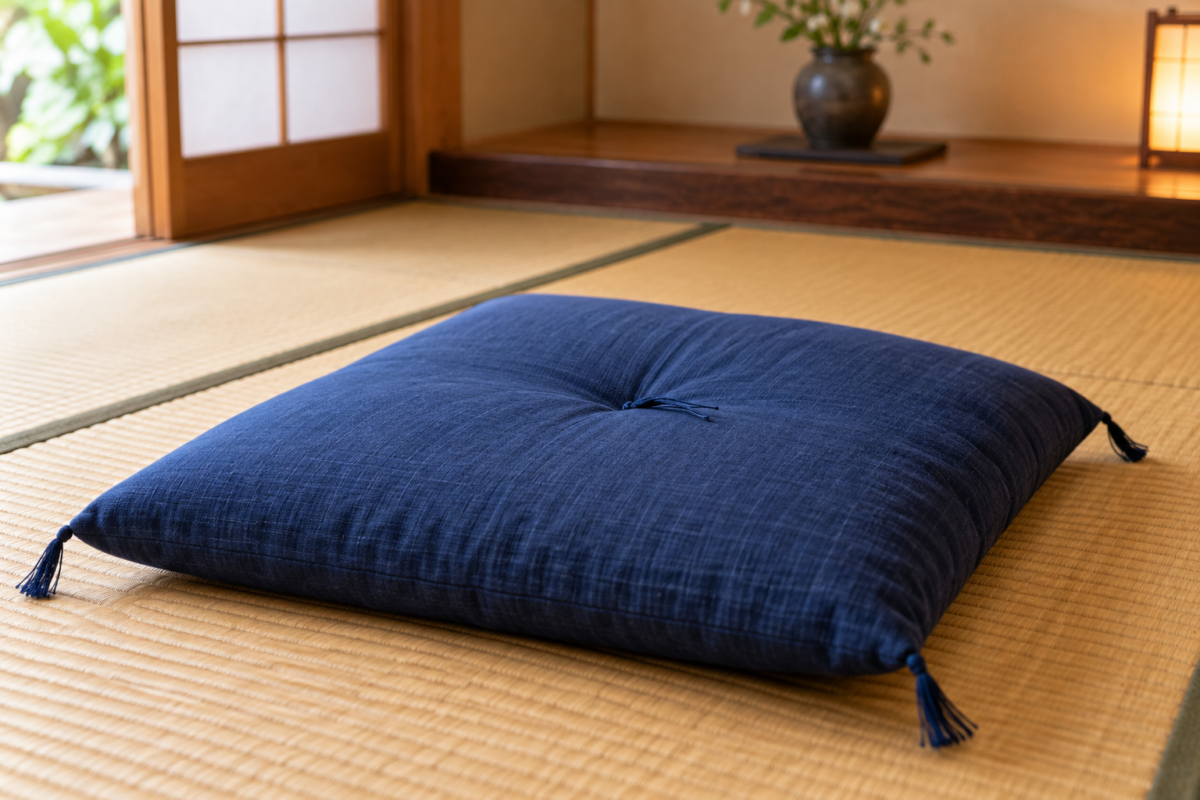
These days, the side of the zabuton with tassels on the central tie is considered the “front (top)” side, and the edge without stitching is considered the “front (facing)” side. If you’re using a zabuton cover, the side where the zipper’s seam allowance overlaps is the “top,” and the side without the zipper is the “front.” When offering a zabuton to a guest, paying attention to its top/bottom and front/back orientation is a mark of thoughtful hospitality.
Master This and Earn Some Respect: How to Sit on a Zabuton (Etiquette)
When you’re invited into a tatami room, do you just sit down on the zabuton right away? Actually, there’s proper etiquette for how to sit on a zabuton. Let’s take a look at the correct way to sit and the manners involved.
・How to Sit on a Zabuton
1: Stand on the lower side (the side farther from the seat of honor) of the offered zabuton and assume the kiza position. Kiza is a posture where you stand on your toes with your heels resting under your bottom.
2: From the kiza position, move briefly into a formal seiza (kneeling) posture. When the host says “please, go ahead,” give a small bow and return to the kiza position.
3: Clench both hands into fists, place them on the floor in front of you, and move your knees forward to bring your legs onto the zabuton. Once seated on the zabuton, face forward and straighten your back.
・How to Get Off the Zabuton
1: Assume the kiza position, place your fists on the floor in front of you, and step off the zabuton one leg at a time. If any wrinkles have formed on the zabuton, smooth them out quickly with your hand.
2: Once off the zabuton, move from the kiza position into seiza and greet the host.
The way you sit down and the way you get up are almost identical, with the key point being that the kiza posture is inserted partway through each movement. Also, as a matter of etiquette when using a zabuton, be careful never to step on it or move it around without permission.
Even though the zabuton is something we use casually in tatami rooms, you may have been surprised to learn just how detailed the etiquette surrounding it is. Being able to sit properly when invited into a tatami room is something to be proud of as a representative of Japanese culture. Why not take this opportunity to master the manners surrounding the zabuton?
 中文 (台灣)
 한국어
한국어 日本語
日本語関連記事一覧
Comment ( 0 )
Trackbacks are closed.
No comments yet.